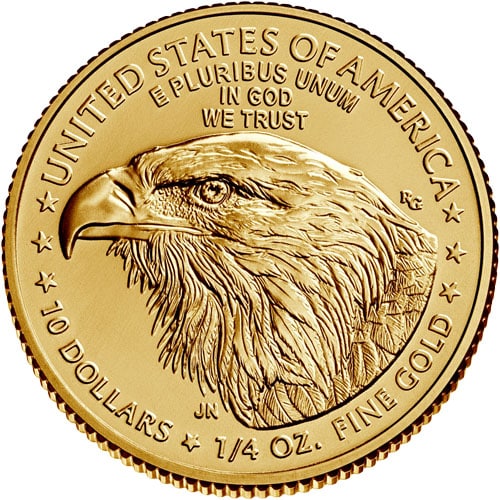

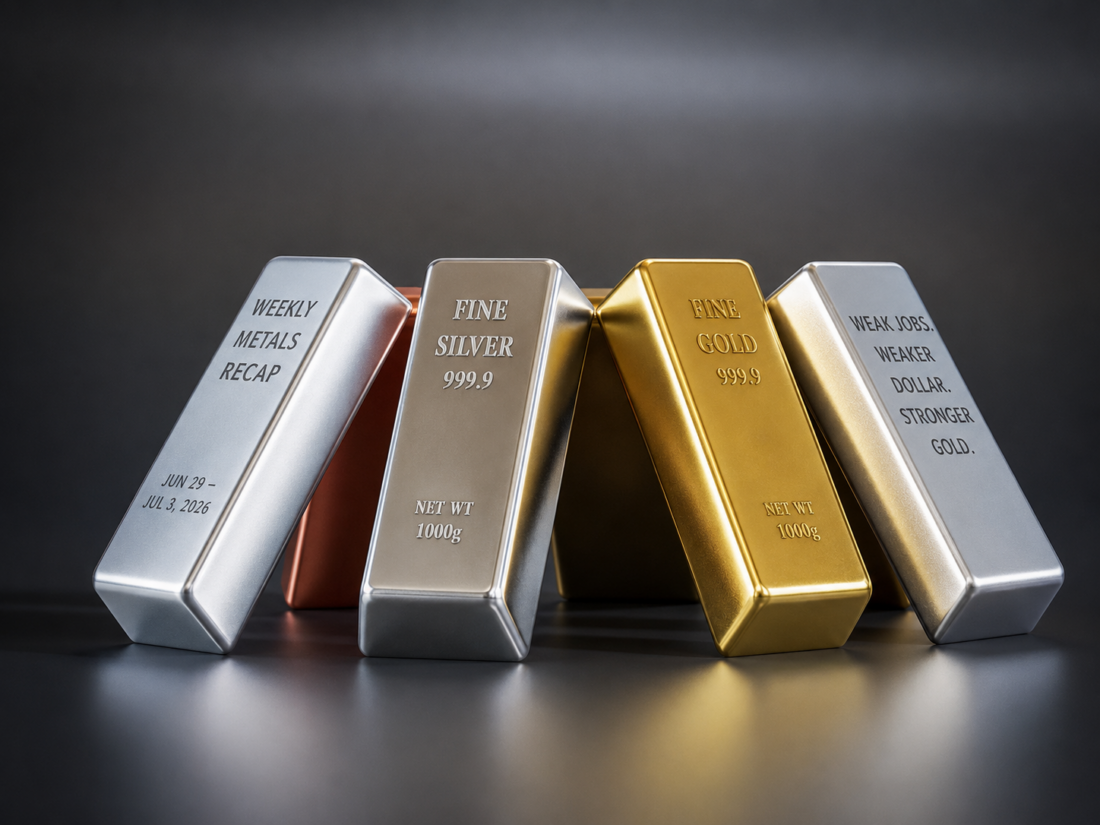
Gold and silver spent Monday and Tuesday getting benched — Iran drama got upstaged by a stock party (Dow hit 52K), hot jobs data, and a Fed that won't budge. Then Thursday flipped the script: a soft payrolls miss sent the dollar packing, gold popped back above $4,100, and silver finally snapped its seven-week slump. Redemption arc, act one. Next week's calendar is quiet — no payrolls to sweat — so Wednesday's FOMC Minutes get the whole stage. Hawkish tone, metals stay grounded. Dovish tone, gold gets to run. Place your bets.
Monday (6.29.26): Gold $4,015.60 · Silver $58.180. Gold and silver got overshadowed by their own storyline today. Iran tensions flared, oil ticked up (WTI +2.2%, Brent +1.6%) as Hormuz traffic hit its weakest since the ceasefire — but instead of a safe-haven rush, everyone piled into stocks (Nasdaq +2.1%, Dow hit a record above 52,000) and treated it as a buying opportunity. Gold fell 1.79%, silver 1.48%, both outvoted by rising yields and the Fed's still-hawkish stance. Moral: geopolitical drama doesn't always mean gold gets to be the main character.
Tuesday (6.30.26): Gold $4,006.70 · Silver $58.470. Gold and silver went their separate ways today. A surprisingly strong JOLTS report reminded everyone the labor market isn't rolling over yet, yields climbed back toward 4.47%, and the Fed's already-hawkish June pivot looked a little more justified. Gold took that personally, dipping 0.22%. Silver just shrugged and kept its momentum going, up 0.50%. Oil couldn't agree on a mood either — WTI dipped, Brent held near $73 — as Hormuz traffic mostly recovered but Iran's still holding the steering wheel on routing. Translation: less panic-buying in gold, more "let's see what happens next.
Wednesday (7.01.26): Gold $4,036.90 · Silver $59.070. Metals kicked off Q3 with a bounce, even as a stronger dollar and higher yields tried to rain on the parade ahead of tomorrow's jobs report. Gold climbed 0.75%, silver ran hotter at 1.03%, briefly poking above $60 before easing back. All eyes are on Thursday's payrolls — ADP already came in soft at 98K, and a miss on the official number could give this rebound legs. Oil's the other subplot: Hormuz traffic is recovering faster than expected, but volumes are still a third of prewar levels — good for oil bears, just a shrug for gold.
Thursday (7.02.26): Gold $4,112.70 · Silver $60.643. Jobs report came in soft, dollar took the hint and left. Payrolls added just 57K vs. 115K expected — a real miss — and the Fed's next move just got pushed to December. Gold popped 1.09%, silver 0.93%, snapping its seven-week losing streak. The 10-year's still parked at 4.5%, so nobody's popping champagne. Oil calmed down too, drifting back to prewar levels as Hormuz traffic steadied out — good news, but not enough to fully unclench gold's geopolitical grip.
Friday (7.03.26): Gold $4,175.50 · Silver $62.220. Markets are closed for the holiday, but gold and silver didn't get the memo. Both are ripping higher in thin trading — gold up 1.30%, silver up a stronger 2.28% — as Thursday's jobs miss keeps chasing the dollar out of the room. Gold's flirting with $4,200, silver's pushing into its first real resistance zone since payrolls dropped. Oil's the calm one in the group chat, drifting back toward prewar levels as Hormuz traffic normalizes — good for inflation, kind of a shrug for gold. Next stop: July 14 CPI, then the July 29 Fed decision. Happy Fourth — trade light, watch the fireworks (and the charts).
–
Gold Surging Back Above $4,100 After Weak Jobs Report
Gold Surging Back as Weak Jobs Shift Fed Expectations
June's jobs report landed way below expectations — payrolls up just 57,000 versus the 115,000 forecast — and gold rewarded the miss immediately, rocketing through $4,100/oz as traders bet the Fed has even less reason to hike anytime soon.
Driving the news
- Nonfarm payrolls rose 57,000 in June, well short of the 115,000 consensus and a sharp step down from May's downwardly revised 129,000
- The unemployment rate actually fell to 4.2%, but only because labor force participation dropped 0.3 points to 61.5% — the lowest since March 2021 — as 507,000 fewer people reported being employed
- May and April payrolls were both revised down (-43,000 and -31,000, respectively), painting a weaker hiring trend than previously thought
- Leisure and hospitality shed 61,000 jobs on soft seasonal hiring, even as professional/business services (+36,000), social assistance (+25,000), and healthcare (+22,000) picked up some slack
- Weekly jobless claims came in at 215,000 for the week ending June 27, below the 220,000 forecast, while spot gold jumped 2.11% to $4,116.72/oz on the combined data release
- The four-week claims average ticked up to 222,000 and continuing claims held near 1.814 million — both roughly in line with expectations
Why it matters
Gold's move is a classic "bad news is good news" reaction: a cooling labor market takes pressure off the Fed to stay restrictive, and traders wasted no time pricing that in — futures rose, Treasury yields fell, and the policy-sensitive 2-year yield dropped to 4.13%. Fed Chair Kevin Warsh had called the jobs picture "steady" just a day earlier while keeping his focus on the 2% inflation target, but Thursday's soft print complicates that narrative and adds fuel to the case that hikes aren't needed this year.
What to watch
Markets have already taken a September rate hike off the table, though October still shows up on the CME FedWatch gauge. Warsh has repeatedly refused to commit to a policy path or offer forward guidance, so upcoming data — especially anything that confirms or reverses this month's participation-driven unemployment dip — could swing expectations quickly in either direction.
The bottom line
A weak jobs number and steady jobless claims gave gold exactly what it wanted: less conviction that the Fed needs to tighten. As long as the labor market keeps sending mixed signals, expect gold to keep trading on rate-path expectations as much as on the headline numbers themselves.
Gold's Rangebound, But the Stage Is Set for a Breakout
The big picture
Gold has fallen hard from $5,500/oz earlier this year to below $4,000 in late June, but the World Gold Council's mid-year outlook says the metal still has clear upside potential for H2 2026 — with central bank demand and long-term investors expected to cushion any further downside.
Driving the news
- WGC's Gold Valuation Framework suggests current prices are broadly aligned with a global backdrop of moderate growth and cooling-but-elevated inflation — implying gold could trade ±5% around $4,100/oz for the rest of the year absent a major shift
- Realized volatility spiked above 50% during the US-Iran conflict and gold's swing from $5,500 to sub-$4,000, though it's since cooled to below 30% — still above the 20-year average of 17%
- Despite the pullback, gold remains one of the best-performing assets of the past 12 months
- Intraday analysis shows most pullbacks happen during US trading hours while rebounds cluster in Asian hours, underscoring Asian investors' growing role in price discovery
- India hiked its gold import duty from 6% to 15% starting in early April to defend the rupee amid oil-driven pressure — a move WGC estimates will cut jewelry, bar, and coin demand by 50-60 tonnes (~10% y/y)
Why it matters
The bull and bear cases are both live. On the upside, a worsening economy, a geopolitical shock, a dovish rate shift, or a wave of dip-buying could push gold back toward $4,500/oz — and a strong enough catalyst could send it sustainably toward $5,000. On the downside, dollar strength, rising yields beyond current expectations, risk-on sentiment, and technical selling could drag prices lower, though WGC believes a 10-15% decline from here would likely trigger bargain-hunting that limits further damage. Central banks — which have bought roughly 1,000 tonnes a year since 2022 — remain a key swing factor; WGC estimates every 20-30 tonne increase above the long-term ~600t average adds about 1% to gold's price, but a marked slowdown in official buying would be a headwind.
What to watch
India's demand trajectory is a wildcard worth watching closely: further economic deceleration could deter Indian buyers even at lower prices, and rising defaults on collateralized gold loans could add unexpected supply to the market. On the official-sector side, WGC's own Central Bank Gold Reserves Survey shows a growing share of reserve managers expect their gold holdings to rise over the next 12 months — but the pace of purchases, not just the number of buyers, will determine how much support that provides.
The bottom line
Gold's first-half rollercoaster shows just how sensitive it is to macro shifts, geopolitical risk, and sentiment — and how much sway Asian demand now holds. WGC expects it to stay rangebound for now, but with real upside if risks flare up, and structural buying from central banks and long-term investors keeping a floor under the downside.
—--
Governments Won't Tolerate Pain, So Gold's Correction Is a Gift, Says Waratah's Dunkley
The big picture
Gold's recent pullback isn't the end of the bull market — it's a buying opportunity, according to Waratah Capital Advisors' Brad Dunkley, who argues policymakers have effectively abandoned the idea of letting recessions or prolonged downturns happen and will keep the economy running hot for years.
Driving the news
- Dunkley, Co-Founder and CIO of Waratah, told Kitco News the long-term bull case for gold stays intact because high debt levels mean rates "can't go up" — governments will print money and run the economy hot instead
- He echoed remarks from earlier this month's Sohn Montreal Investment Conference, where he framed structural monetary debasement — not short-term inflation — as gold's real secular driver
- Gold's climb from roughly $35/oz in the early 1970s to over $4,500/oz today is his benchmark for the metal's long-run purchasing-power preservation
- Rising geopolitical fragmentation and central bank distrust are cited as an added structural pillar behind gold demand
- Waratah doesn't hold physical gold — it's concentrated in gold producers, which Dunkley says are still pricing in a lower long-term gold price than the current spot level
- Preferred holdings include Artemis Gold, Alamos Gold, and IAMGOLD, with Canadian producers favored for jurisdictional stability
Why it matters
Dunkley's thesis rests on a policy playbook he says has fundamentally changed: no recessions, no meaningful unemployment spikes, and stimulus at the first sign of trouble. That combination — financial repression plus persistent monetary expansion — is what he believes keeps real rates suppressed and gold structurally supported, regardless of near-term Fed rhetoric on staying restrictive. On the equity side, he and Associate Portfolio Manager Grant McAdam argue miners are mispriced relative to their fundamentals — generating standout free cash flow margins and, in many cases, sitting net cash — even as institutional investors remain broadly underweight the sector because generalist equity markets have kept delivering strong returns elsewhere.
What to watch
Dunkley expects generalist investors to rotate into gold miners only once broader equity markets stumble — a dynamic he compares to the 1970s, when gold and energy outperformed during a period of equity multiple compression. Continued sector consolidation is also on his radar, as senior producers look to replace declining reserves through acquisitions of smaller Canadian names.
The bottom line
Dunkley isn't betting on bullion so much as on the belief that policymakers will never let the economy hurt for long — and in a world where that holds true, cash-gushing, undervalued gold producers look like some of the best businesses on the market, whether investors have noticed yet or not.
—--
ECONOMIC CALENDAR
Monday, Jul. 6
- 9:45 am — U.S. Services PMI (Jun.)
- 10:00 am — ISM Services PMI (Jun.)
Tuesday, Jul. 7
No events scheduled
Wednesday, Jul. 8
- 2:00 pm — FOMC Meeting Minutes and Economic Forecast
- 3:00 pm — Consumer Credit (May)
- 8:00 pm — BoE's Breeden, NY Fed's Williams, and Dallas Fed's Logan speak at The Future of Market Liquidity and Functioning Workshop
Thursday, Jul. 9
- 8:30 am — Weekly Jobless Claims (Jul. 4)
- 10:00 am — Existing Home Sales (Jun.)
Friday, Jul. 10
No events scheduled
—--
IMPACT ON PRECIOUS METALS MARKETS
U.S. Services PMI (S&P Global)
- Strong reading = services sector accelerating, economy resilient = mild headwind for gold.
- Weak reading = services activity slowing = supportive for metals.
As the services sector accounts for the bulk of U.S. economic output, this flash-to-final read gives markets an early gauge of how the broader economy is holding up heading into the more closely watched ISM print two days later. Low to moderate impact.
ISM Services PMI
- Reading above 50 = services sector expanding, economy firm = mild headwind for gold.
- Reading below 50 = contraction signaled = tailwind for metals.
Since services make up roughly 80% of U.S. GDP, this report carries outsized weight relative to its manufacturing counterpart, and its price and employment sub-indices often draw as much attention from rate-setters as the headline number itself. Moderate to high impact.
FOMC Meeting Minutes and Economic Forecast
- Hawkish tone / fewer projected cuts = higher-for-longer rates = headwind for gold.
- Dovish tone / more projected cuts = easing path reinforced = tailwind for gold and silver.
The minutes offer the fullest look at how individual committee members are weighing inflation risk against labor market softening, often revealing dissent or nuance that the post-meeting statement glosses over — and any shift in the dot plot narrative can move rate-cut odds sharply. High impact.
Consumer Credit
- Strong credit growth = households still spending, confidence intact = mild headwind for gold.
- Weak or contracting credit = consumers pulling back = supportive for metals.
This report is a lagging and comparatively minor release, watched more for early signs of consumer strain — particularly in revolving credit and delinquency trends — than for any immediate market-moving surprise. Low impact.
Fed Officials Speak at Market Liquidity Workshop
- Commentary emphasizes market stability / no urgency to act = neutral-to-mild headwind for gold.
- Commentary flags liquidity stress, funding strains, or dovish policy hints = supportive for metals.
Appearances by New York Fed President Williams alongside the Bank of England's Breeden and Dallas Fed's Logan center on market plumbing and liquidity rather than the rate outlook directly, but off-the-cuff remarks on policy or financial stability risk can still move markets, particularly during Q&A. Low to moderate impact.
Weekly Jobless Claims
- Claims rising = labor market softening = good for metals.
- Claims falling = job market still tight, Fed in no rush to ease = mild drag on metals.
This week's release lands ahead of a holiday-shortened trading period, which can thin liquidity and exaggerate the market's reaction in either direction. Moderate impact.
Existing Home Sales
- Strong sales = housing demand resilient, consumer healthy = mild headwind for gold.
- Weak sales = high rates and affordability pressures biting = supportive for metals.
Existing home sales respond closely to mortgage rate moves, making this release a useful proxy for how restrictive current Fed policy actually feels on the ground — a sharp slowdown here often feeds directly into rate-cut expectations. Moderate impact.